| Graphics: |  5 5 |
| SFX: | 5 |
| Music: |  4 4 |
| Gameplay: | 5 |
| Challenge: |  3.5 3.5 |
| Replay: | 3 |
| Overall: | 4 |
| Genre: | Sim/Strategy |
| Reading ability: | Minimal |
| Developer: | Interbec |
Background:
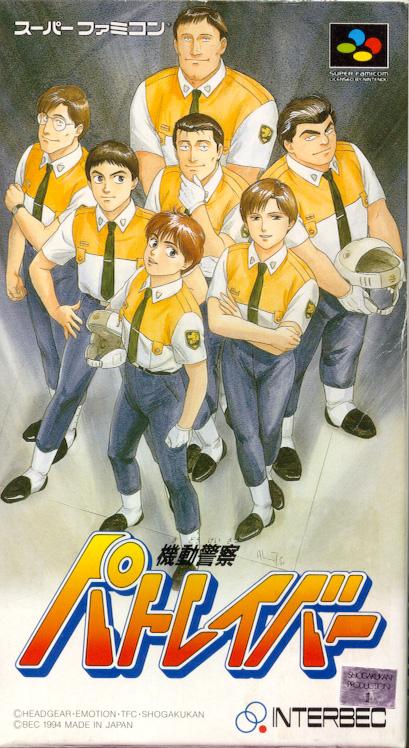
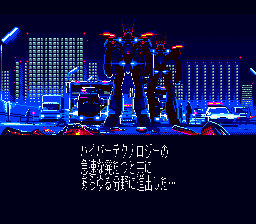
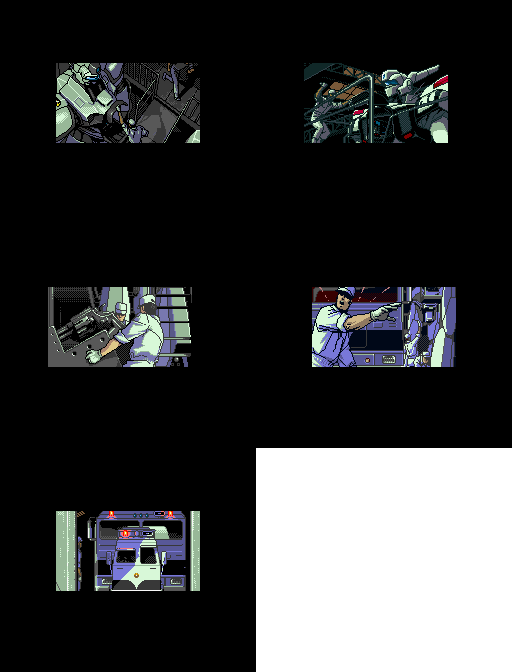
Patlabor was an SF manga/anime series set in the then-immediate future (the late '90s), which would make it an alternate timeline now. A dam has been built across Tokyo Bay, which has been drained for real estate development. This is called the Babylon Project. Giant mecha, or "Labors," have been developed at this time. Some are military, some are for construction. The Patlabor Mobile Police was made to patrol and control the activities of Labors and to make sure that their use is not to be abused. The story for the Patlabor game involves the characters of the SV2 Second Unit. The characters in the game are Captain Gotoh, Forwards Noa Izumi and Isao Ohta, Backups Asuma Shinohara and Takeo Kumagami, drivers Hiromi Yamazaki and Mikiyasu Shinshi, as well as Seitaro Sakaki and Shigeo Shiba. The events of this game start on January 7, 2001. Kanuka Clancy is not in this game, and instead you will see Takeo Kumagami. The uniforms that are worn are that of the manga as opposed to the anime, which would set this game in the manga continuity. Actually, there are at least three continuities for Patlabor: the manga, the OVA, and the TV series. If there are any others, I almost don't want to know.
The Game:
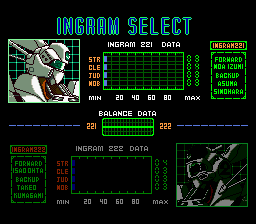
The game presents a series of missions for you to accomplish. To prevent monotony, the missions come in a variety of objectives, just as in the show. Many times, it is not in your best interest to draw your gun in order to defeat the perpetrators, which Ohta is prone to do in the show. You must subdue rogue Labors, negotiate with terrorists, solve mysteries, and save a neighborhood from wild pigs. Before each mission, you must choose between Noa and Ohta to take on the mission. The selection screen shows the stats of each Ingram. Just as in the show, your Ingrams are like infants ready to learn and adapt to their pilots. As you accumulate experience, you learn new combat moves.
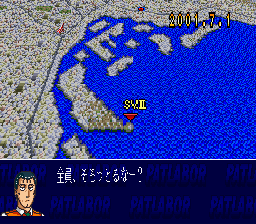
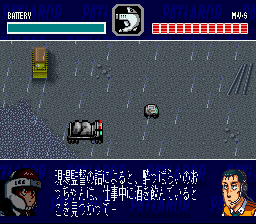
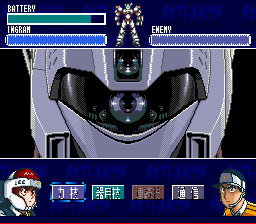
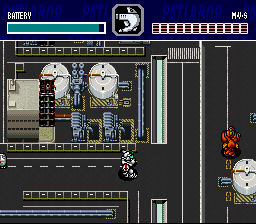
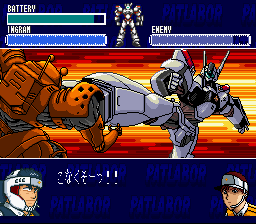
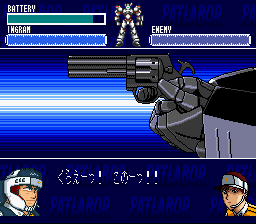
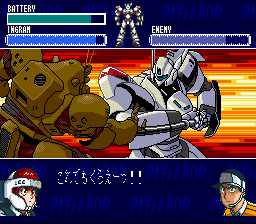
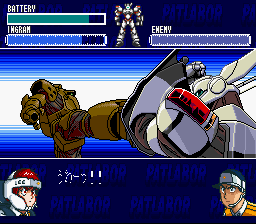
The top part of the screen shows your Ingram's battery charge, a pilot's helmet symbol (or "headgear mark" as the instructions call it), and something the instructions call an MVS gauge. You move your Ingram around the field as you would expect, and you can recharge your battery by visiting your carrier. When the MVS gauge fills up, you can select your actions when the headgear mark lights up. You will want to press the button quickly before your opponent has a chance to initiate an attack. When you attack, you get to choose from a menu of different attacks that grows as your experience increases, such as punch, kick, tackle, pistol, stun stick, trip wire, etc. When you defend yourself from attack, you get to choose between dodging and blocking the attack, and when you become more experienced, you can use your enemy's attack against them, as in Judo techniques. Between missions, it is a good idea to practice against another Ingram to give you more experience. This is where the level-grinding takes place in order to raise your EXP. And be sure to keep good stats for both pilots, as some missions are more suitable to one pilot than the other. And a hint: the final level will have you switching between both Noa and Ohta in different locations.
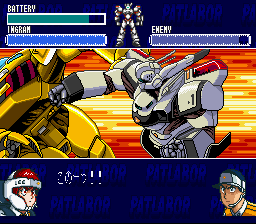
Graphics:
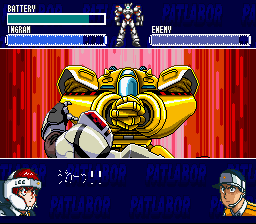
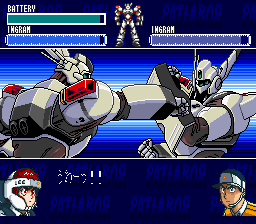
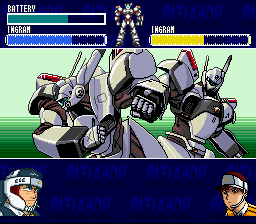
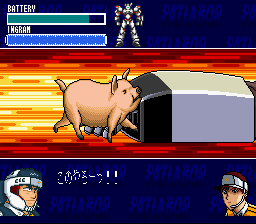
Beautiful. Graphics are top notch. There is no rendered animation, and each action sequence displays the mecha as static images moving about each other. But just as with typical Japanese animation, the game employs the ubiquitous scrolling motion lines to give a sense of motion and action. The net result is that despite the lack of animation frames, the action is represented fantastically. As you can see in the screenshots, the graphics are very sharp and detailed.
Music/Sound:
Patlabor offers three sound settings: Mono, Stereo 1 and Stereo 2. Stereo 2 is Dolby Bass Boost (DBB), which offers a deeper, richer sound to the game. The game does not feature the music from the show at all, but then again this game seems to be based off the manga, so I'll let that pass. The game's music is nice though and even when it is repetitive (such as during the sparring training), it is not annoying. While the games doesn't have digitized voice samples or anything, it does faithfully replicate the sound effects that the Labors make when they move, just like in the show, giving the mecha a very familiar feeling.
Challenge and replay:
The game starts out simple and gradually becomes challenging. Each mission is unique, adding variety to the game. For example, the second mission has you negotiating with an Iranian terrorist, and you have to choose your responses to keep him from detonating his bombs. Mission 3 has you battling two labors simultaneously, and mission 4 is a challenge of dexterity as you must capture loose pigs in a neighborhood that have run amok.
There's not much replay to the game to provide a considerably different experience each time. It's just a game that once you finish, you probably aren't likely to play it again until a few years later at least.
Secrets:
When I beat the game, after the credits scroll it said: "Special techniques are hidden. More than 5 in this game!" I'm not sure what this is all about, and I'm not sure as to what these "special" techniqes are. If you know the secrets, please e-mail me!
The Good:
I really like the interaction between all of the characters. The game can be enjoyed without understanding all of what they're saying, however. The gameplay is excellent, as it is simple and easy to understand even without knowing how to read Japanese. It is not as difficult as playing a more complex Japanese-only game, such as Super Robot Taisen, since the options presented are pretty straightforward and easy to select. It's also nice that you can always continue if you screw up. You do not have to worry about running out of continues or reloading your saved game.
The Bad:
Many parts of the game were just too easy. Even when I find my Ingram outnumbered by other Labors 3 to 1, I often have no trouble subduing my opponents. Perhaps that is because I was constantly level grinding between missions. Although I must say that the red Ingram "Salamander" and the CLD-1 "Gustav" proved to be worthy opponents.
Overall:
Although it is possible to go through the game without knowing how to read Japanese, it sure does help. When I first played this game, I only have a limited Japanese reading ability, and I had some difficulty with not knowing what to do in certain parts of the game. In one part of the game, you must negotiate with an Iranian terrorist correctly or else he'll blow up the entire area. I got through this with only being able to read a few words and guessing the rest. I bought the game after I was told that knowing Japanese is not necessary to play the game. Anybody is able to get through the game with some difficulty, but you would get more out of the game if you knew what was going on more. If you can't read Japanese, you will be clueless about the storyline. That's why I recommend that one should have some reading ability to play the game to get the most enjoyment from this game. But still, the game is lots of fun just for the action, by simply beating up Labors with my Ingrams. I recommend this game mainly for fans of Patlabor.

 Back to the Anime Super Famicom Game Reviews Index
Back to the Anime Super Famicom Main Page
